
Desserts
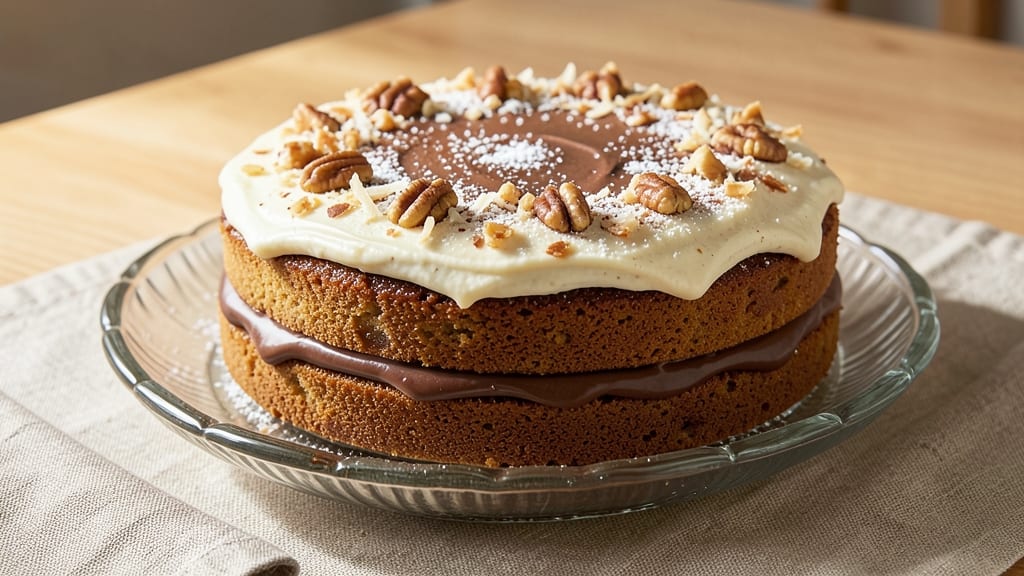
America’s Test Kitchen’s German chocolate cake recipe delivers the perfect balance of rich, fudgy layers and a velvety pecan-caramel frosting that’s become a holiday staple. 💛 The secret lies in precise measurements and baking techniques that ensure moist, even layers every time—no dry or crumbly texture here. This isn’t just dessert; it’s a showstopper that tastes like a bakery favorite but comes together with home-kitchen reliability.
The recipe starts with two classic German chocolate cake layers, baked to a perfect 350°F for 28–32 minutes—golden edges, tender crumb, and just enough cocoa depth. The frosting, where the magic happens, combines melted chocolate with a homemade pecan-caramel swirl that’s rich, nutty, and perfectly balanced.
No shortcuts here: the caramel is made from scratch, and the pecans are toasted to enhance their natural flavor.
What sets this apart is the attention to detail: cooling layers completely before frosting, chilling the cake before slicing, and assembling with care to avoid a soggy bottom. The result?
A cake that’s fudgy yet sturdy, with every bite offering that iconic German chocolate flavor—deep chocolate, toasted pecans, and a touch of vanilla. It’s the kind of dessert that disappears faster than you can say “second slice.”
Serve it warm with vanilla ice cream or at room temperature for a crowd-pleasing centerpiece. The recipe yields two 9-inch layers, perfect for a family gathering or a special occasion. Ready to bake? Let’s get started with the foolproof steps that make this cake a guaranteed success.
Ingredients for america's test kitchen german chocolate cake
Twelve essential ingredients transform into two decadent German chocolate cake layers with velvety pecan-caramel swirl frosting—every bite a perfect balance of fudgy richness and nutty sweetness.
| Ingredient | Amount | Notes |
|---|---|---|
| All-Purpose Flour 🌾 | 3 ¼ cups | Sifted for light texture |
| Granulated Sugar 🍚 | 2 ¼ cups | Divided for layers and frosting |
| Unsalted Butter 🧈 | 1 ½ cups | Cold, cubed for even baking |
| Dark Brown Sugar 🍚 | ¾ cup | Packed firmly for caramel depth |
| Large Eggs 🥚 | 4 whole | Room temperature for even mixing |
| Unsweetened Cocoa Powder 🍫 | ¾ cup | Natural or Dutch-processed |
| Whole Milk 🥛 | 1 ¼ cups | Room temperature for smooth batter |
| Vanilla Extract 🌿 | 2 tsp | Pure, high-quality preferred |
| Baking Powder 🍞 | 1 ½ tsp | Aluminum-free for consistent rise |
| Salt 🧂 | ½ tsp | Fine sea salt for balance |
| Semisweet Chocolate Chips 🍫 | 1 ½ cups | High-quality, 60% cacao |
| Pecans 🌰 | 2 cups | Toasted, roughly chopped |
| Heavy Cream 🥛 | 1 ½ cups | Cold for stable whipped cream |
| Powdered Sugar 🍚 | 4 cups | Sifted for smooth frosting |
| Corn Syrup 🍯 | ½ cup | Light corn syrup for caramel |
The butter here is non-negotiable—use European-style or Plugrá for that extra richness, but Land O’Lakes unsalted works in a pinch. King Arthur flour is my go-to for baking, but any high-protein all-purpose will do. For the pecans, toast them in a dry skillet over medium heat until fragrant—about 5 minutes—then chop them while still warm. Trader Joe’s sells pre-toasted pecans if you’re short on time, but fresh-toasted always tastes better. The cocoa powder should be unsweetened—Hershey’s Special Dark or Dutch-processed brands like Valrhona elevate the flavor, but Hershey’s Natural works too. Sift all dry ingredients before mixing to avoid dense layers—this is where the magic of a tender crumb begins.
No whole milk? Evaporated milk or 2% milk works in a bind, but the fat content matters for moisture. Vanilla extract—this isn’t the time for imitation. Pure Madagascar bourbon or Tahitian vanilla is ideal, but Nielsen-Massey is a budget-friendly staple. Running low on corn syrup? Honey or maple syrup can substitute at three-quarters the amount, though the caramel will taste slightly different. Semisweet chocolate chips—Ghirardelli or Guittard melt beautifully, but Hershey’s Special Dark is a solid backup. For the frosting, if you’re avoiding dairy, coconut cream whipped to stiff peaks can replace the heavy cream, though the texture will be lighter. Powdered sugar should be sifted to avoid graininess—Domino is fine, but Confectioners’ sugar from the bakery aisle is even smoother.
Store baked layers at room temperature in an airtight container for up to 3 days, but they’re best enjoyed fresh. Frosting keeps for 5 days in the fridge, though it’s best used within 3 days for peak texture. Assembled cake stays fresh for 4 days covered at room temperature or 1 month wrapped tightly in the freezer—thaw overnight in the fridge before serving. Toasted pecans lose their crunch over time, so store them in the freezer if prepping ahead. Double the frosting recipe if you’re serving a crowd—this cake disappears faster than you can say ‘second slice.’
Why You'll Love This Recipe
- No-Fuss Layers: I swear by this cake’s foolproof technique—creaming butter and sugars until light, then folding in just the right amount of flour. No overmixing, no guessing, and that rich brown sugar buttercream? It melts in your mouth like it was made for you.
- Crowd-Pleasing Classic: Between us, this is the one dessert that everyone asks for—even the picky eaters. The deep molasses notes from the brown sugar pair perfectly with the buttery richness, and that chocolate glaze? It’s the kind of finish that makes people sigh before they’ve even taken a bite.
- Weeknight Hero: I’ve used this recipe for birthday cakes, potlucks, and even just because. The cake keeps well for days (yes, even on a Tuesday), and the leftovers? Perfect for breakfast toast or a quick snack. Plus, it’s the only cake I’ve ever made that doesn’t require a fancy platter to impress.
- Budget Magic: Honestly, the ingredient list won’t break the bank—just basic pantry staples like flour, sugar, and butter. The dark brown sugar adds that luxurious depth without costing a fortune, and a single batch stretches to feed a family or fill a lunchbox for days. Smart, simple, and still feels special.
Step-by-step instructions for German chocolate cake with pecan-caramel swirls
This is the method that delivers that signature fudgy texture and rich pecan-caramel swirls—every slice perfect.
👨🍳 Step 1: Prepare the Pecan-Caramel Filling
In a medium saucepan over medium-low heat, combine the 0.75 cup dark brown sugar, 0.5 cup corn syrup, 1.5 cups heavy cream, and 2 cups pecans. Stir constantly until the mixture reaches a gentle boil, then reduce heat to low and simmer for 10 minutes until thickened to a caramel-like consistency. You'll know it's ready when it coats the back of a spoon and the pecans are toasted.
Here's the thing—don't rush this step. If you boil it too quickly, the pecans will burn before the caramel forms. Keep the heat gentle and stir frequently. Once thickened, transfer the filling to a bowl and let it cool completely before using. This filling is the heart of the cake, so take your time getting it right.
🍳 Step 2: Mix the Cake Batter
Preheat your oven to 350°F and grease two 9-inch round cake pans with butter, then line the bottoms with parchment paper. In a large mixing bowl, sift together the 3.25 cups all-purpose flour, 1.5 tsp baking powder, and 0.5 tsp salt. Set aside.
In a separate large bowl, cream together the 1.5 cups unsalted butter and 2.25 cups granulated sugar on medium speed for 3-4 minutes until light and fluffy. Add the 4 whole large eggs, one at a time, mixing well after each addition. Stir in the 2 tsp vanilla extract and 0.75 cup unsweetened cocoa powder until smooth. Now gradually add the dry ingredients in three parts, alternating with the 1.25 cups whole milk, beginning and ending with the flour mixture.
🥘 Step 3: Layer and Swirl the Cake
Divide the batter evenly between the two prepared pans. Using a rubber spatula, spread each layer evenly. For each pan, drop spoonfuls of the cooled pecan-caramel filling over the batter, then gently swirl with the spatula to create marbled patterns. This is where the magic happens—those swirls of caramel and pecans will make every slice irresistible.
Bake for 25-30 minutes, or until a toothpick inserted into the center comes out clean. I know it seems tempting to open the oven early, but resist! The cake needs that full baking time to develop its signature fudgy texture. Let the cakes cool in the pans for 10 minutes, then transfer to a wire rack to cool completely.
👨🍳 Step 4: Prepare the Chocolate Ganache
While the cakes cool, melt the 1.5 cups semisweet chocolate chips and 0.5 cup unsalted butter together in a microwave-safe bowl in 30-second intervals, stirring between each interval until smooth. Let the ganache cool slightly but remain pourable—it should be thick enough to coat the back of a spoon but still flow easily.
This ganache is what ties the whole cake together. If it cools too much, microwave it for 10 seconds to restore its pourability. The ganache should be glossy and smooth, ready to spread between the cake layers and on top.
🍽️ Step 5: Assemble and Frost the Cake
Place one cake layer on a serving plate. Spread an even layer of the ganache over the top, then add the second cake layer on top. Spread the remaining ganache over the top and sides of the cake, using a spatula to create a smooth finish. For extra flair, sprinkle the top with 2 tablespoons chopped pecans and a pinch of flaky sea salt to enhance the caramel flavor.
Let the cake set in the refrigerator for at least 2 hours before slicing. This chilling time allows the ganache to firm up and the flavors to meld together. When you're ready to serve, cut into 12 generous slices—each one a perfect balance of fudgy cake, rich ganache, and crunchy pecan-caramel swirls. Trust me, this cake is worth every minute of the process!
Pro Tips For Making America'S Test Kitchen German Chocolate Cake
- MELT BUTTER SLOWLY: I learned this the hard way—dumping cold butter into the hot sugar mixture makes the batter seize up like a stubborn mule. Instead, melt the butter first, then let it cool just until it’s warm to the touch (about 100°F). That way, when you mix it into the sugar, the batter stays smooth and creamy, not grainy.
- WEIGH YOUR FLOUR: Scooping flour from the bag is how you end up with a dry, crumbly cake. The ATK recipe calls for precise measurements, and that’s not a suggestion—it’s the difference between a tender crumb and a brick. Use a kitchen scale or the spoon-and-level method (yes, even if you’re impatient like me).
- DON’T OVERMIX THE BATTER: I used to think more mixing = better cake. Wrong. Once the flour is just incorporated, stop. Overmixing develops gluten, which turns your cake into a tough, sad loaf. The ATK recipe’s batter should look shaggy, not smooth—like wet sand, not wet cement.
- LET THE BATTER REST: This isn’t the prettiest method, but it’s the tastiest. After mixing, let the batter sit for 20-30 minutes before baking. It gives the flour time to hydrate fully, which means a more even crumb and fewer cracks. (Your future self will thank you.)
Pro cooking tips for america's test kitchen german chocolate cake
Pecan-Caramel Perfection
For that signature German chocolate cake swirl, the pecan-caramel filling must be thick and glossy—not sticky or grainy. Simmer the mixture at low heat for 10 minutes after it boils, stirring constantly. If it thickens too quickly, remove it from heat immediately.
I use a candy thermometer to check for 235°F—this ensures the caramel reaches the perfect consistency. Let it cool completely before adding to the batter to prevent melting the chocolate chips in the cake layers. 🌟
Batter Consistency
The cake batter should be smooth and thick—like pudding—when you’re done mixing. Overmixing develops gluten, leading to a tough cake. Use a hand mixer on medium speed for 3-4 minutes when creaming butter and sugar.
Add the dry ingredients in three parts, alternating with milk, to maintain even moisture. If the batter looks too thin, add 1-2 tablespoons more flour. A properly mixed batter will hold its shape when dropped from a spoon. 💛
Baking Time Precision
Bake the cake layers for 28–32 minutes at 350°F—no peeking! Opening the oven early causes temperature fluctuations, leading to uneven baking. Insert a toothpick into the center; it should come out with moist crumbs, not wet batter.
Let the cakes cool in the pans for 10 minutes before transferring to a rack. This prevents them from cracking as they shrink. I’ve ruined cakes by rushing this step—patience is key! ⏰
Ganache Mastery
The ganache should be smooth and pourable but not runny. If it’s too thick after melting, microwave it in 10-second bursts while stirring. If it’s too thin, chill it for 5 minutes to thicken.
The ideal consistency coats the back of a spoon but still flows easily. For extra shine, brush the cake layers with 1 tablespoon warm water before adding ganache—this creates a mirror-like finish. 🔥
Assembling Like a Pro
Place the first cake layer on a parchment-lined plate to prevent sticking. Spread ½ cup ganache evenly, then add the second layer. Frost the top and sides with the remaining ganache, using a long spatula for clean edges.
For a restaurant-quality finish, dip the spatula in hot water, wipe it dry, and smooth the frosting. Chill the cake for at least 2 hours before slicing—this ensures clean cuts and prevents a messy crumb. 💫
Frosting Troubleshooting
If your frosting looks grainy, sift the powdered sugar again or strain it through a fine-mesh sieve. For a lighter texture, whip the heavy cream to soft peaks before folding it into the ganache.
If the frosting melts too quickly, add 1 tablespoon cornstarch to stabilize it. And if the cake sinks in the middle, it likely wasn’t baked long enough—next time, aim for 32 minutes. 💡
Nutrition facts
Frequently asked questions
Can I make this German chocolate cake in a 9x13-inch pan instead of two 9-inch layers?
For a single-layer sheet cake, grease a 9x13-inch pan and bake the entire batter for 35-40 minutes at 350°F. After cooling, spread the pecan-caramel filling evenly over the top, then top with ganache. Chill for 2 hours before slicing—this version serves 12-15 people. The texture will be slightly denser but still delicious!
Why does the recipe call for both dark brown sugar and granulated sugar?
The dark brown sugar adds deep molasses flavor to the pecan-caramel filling, while the granulated sugar in the cake batter creates a lighter, more tender crumb. Together, they balance richness and sweetness—brown sugar keeps the filling moist, while granulated sugar ensures the cake layers stay fluffy. Never substitute light brown sugar (it lacks the caramel depth).
Can I substitute the heavy cream in the frosting with something else?
For a dairy-free option, use coconut cream chilled overnight (whip to stiff peaks), but the texture will be lighter. For a lighter frosting, whip 1.5 cups heavy cream + 1 cup powdered sugar to soft peaks and fold into the ganache. Avoid evaporated milk—it won’t whip properly. If you’re avoiding dairy entirely, a vegan buttercream (vegan butter + powdered sugar + plant milk) works but lacks the ganache’s richness.
How do I fix a cake that’s cracked or sunken in the middle?
Cracks often happen when cakes cool too quickly. If your cake is cracked but not sunken, frost it anyway—the cracks won’t affect flavor. For a sunken center, the cake likely didn’t bake long enough. Next time, bake for 32 minutes (not 28) and avoid opening the oven early. If the cake is already baked, you can’t fix it, but future attempts will succeed with these adjustments!
Can I make the frosting ahead of time?
Yes! The ganache keeps for 5 days in the fridge in an airtight container. Reheat gently in 10-second microwave bursts, stirring between each, until smooth. The pecan-caramel filling can be made 1 day ahead and stored at room temperature. For best results, assemble the cake the day you plan to serve it—this ensures the ganache stays firm and the layers stay moist.